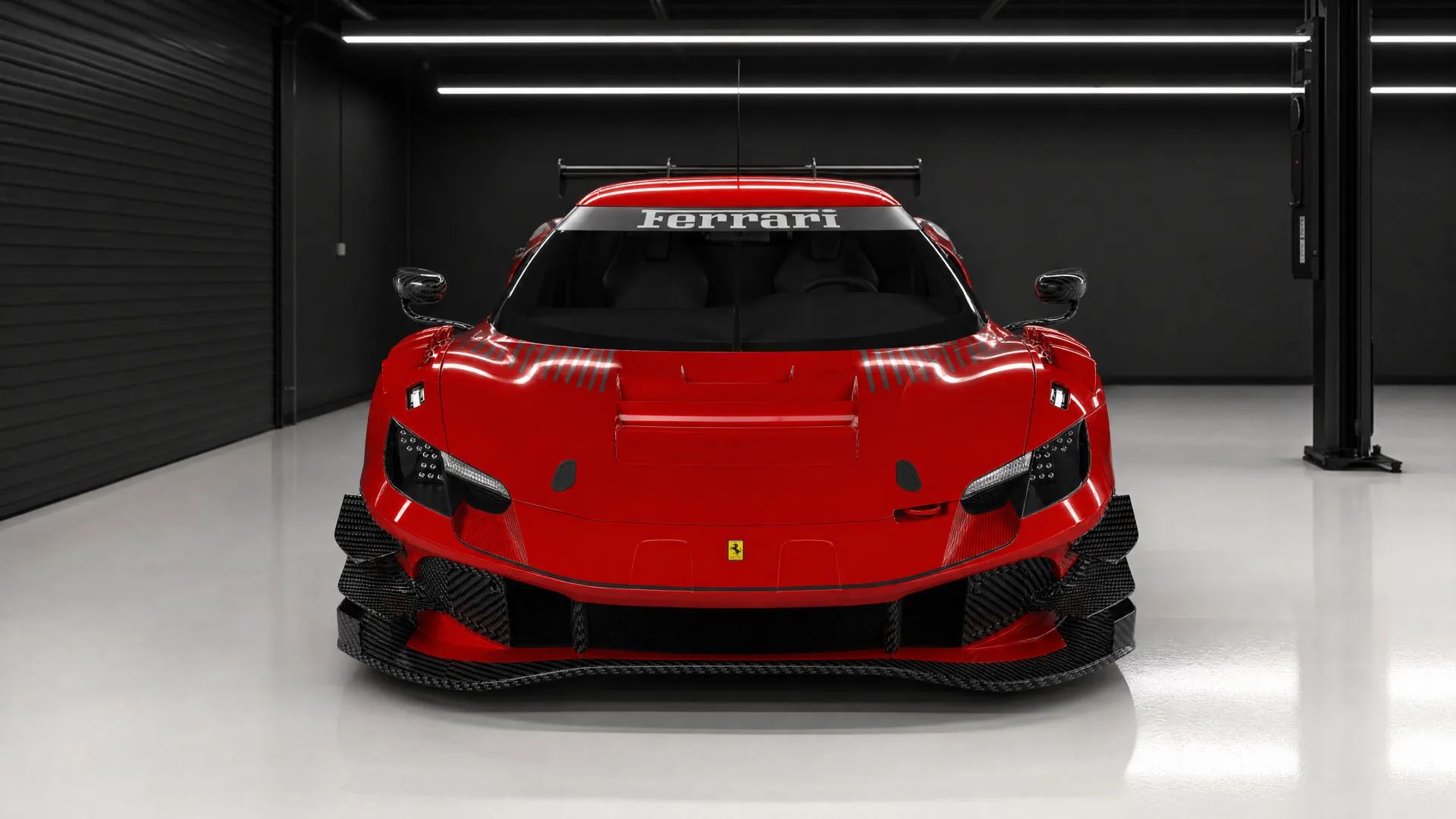
The brief was almost a challenge. The car was pristine — 8,400 km, a factory Rosso Corsa 322, and a service history that read like a jeweller's inventory. The owner wanted the GT3 language: the sculpted intakes, the swan-neck wing, the exit ducts behind the front wheels. But nothing under the skin was to change. It had to remain a road car, MOT-legal, and drivable to the shops.
We started with a full 3D scan. The 296's rear haunches are subtly asymmetric from the factory — the exhaust routing pulls the right-hand quarter panel about 4 mm outward. Any widebody that ignores this looks wrong the moment you walk around the back. We built the flare geometry off the scan, not the CAD model, and the difference in fit is the reason the panel gaps look factory rather than aftermarket.
The hardest single component was the front bumper. GT3 aero moves a lot of air through the nose, but we couldn't run the same duct routing because the road car has crash structure where the racing car has a splitter blade. The compromise was a two-piece splitter: a shallow permanent element bonded to the bumper, and a deeper removable blade the owner clips on for track days. He hasn't taken it off in six months.
Every panel is a hybrid layup — glass composite substrate with a woven carbon outer skin, vacuum-bagged and cured overnight. It gives us the surface quality of solid carbon while capturing roughly 60% of the weight savings a full-carbon build would deliver. The rear wing is the exception; it's a single-piece carbon element pulled from a mould we developed in-house, mounted on machined 7075 aluminium stanchions.
The car went home on a covered transporter after 11 weeks in the shop. The owner sent a photograph three days later, taken outside a café in Modena, with a note that read: 'It's what I wanted before I knew what I wanted.' We keep it pinned above the workbench.